
Genocide for Trade: The Uruguayan Wool, Erasure of the Charrúa and Atlantic Amnesia
✷ Monica Perez ✷ 27/05/2025 ✷ London /Los Angeles/Uruguay ✷ For ARK Parrhesia ✷
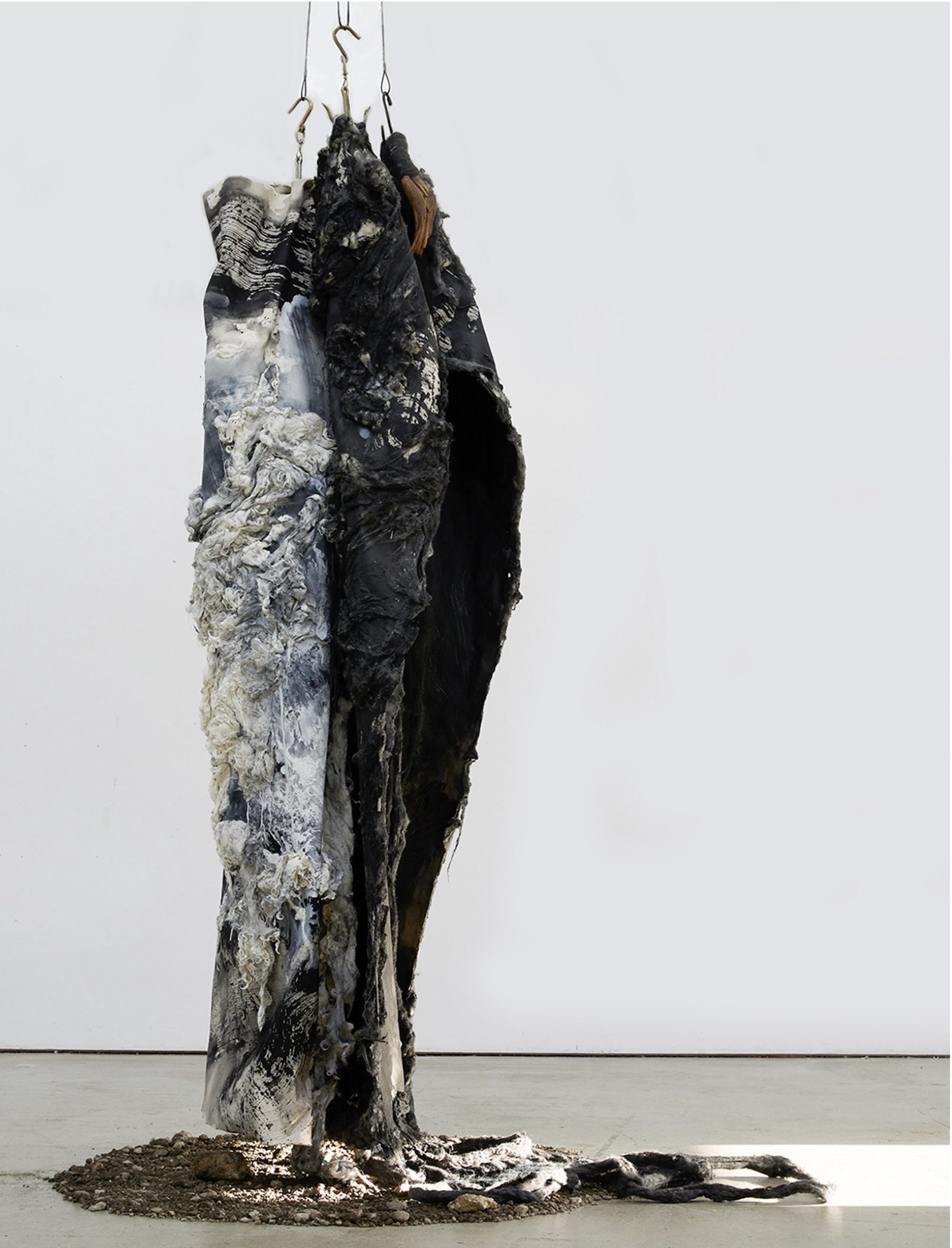
Monica Perez, COST.1831. British raw wool, antique Georgian sack/net hook (c. 1820), oil, wax, eucalyptus wood (from Uruguay), hair, pigment, British soil, clay, canvas. 120cm x 244cm x 101 cm. 2025.
The Salsipuedes Massacre, Indigenous dispossession, and Uruguayan wool as a carrier of colonial violence into European material culture.
Uruguay’s first president, Fructuoso Rivera, staged the Salsipuedes Massacre—luring Charrúa leaders into a peace meeting, then killing them to clear land for wool production.
As British naval officer Thomas Cochrane secured Atlantic trade routes, the massacre unfolded in parallel with imperial expansion. The event marked both the near-erasure of the Charrúa and the beginning of a national amnesia—genocide buried under trade. “COST” examines the relationship between England and South America during the British Empire’s expansion, focusing on colonies established to exploit resources and cheap labor.
In Uruguay, wool became a primary resource, contributing to the genocide of Indigenous people. For years, wool gained at the cost of life and liberty crossed the Atlantic into European soil, with consumers unaware of the accompanying crimes. This resonates with Dussel’s critique of Eurocentric narratives that often erase the agency and voices of those on the periphery.¹
The choice of wool, a material deeply intertwined with the transatlantic trade and colonial economies, is a reminder of the historical injustices embedded within global commodity chains. It serves as a reminder of the genocidal amnesia of the Charrúas by the Uruguayan government. At the same time, allied European powers allowed the Pampas, a vast, fertile grassland, to be cleared for grazing, erasing Indigenous identities.
Enrique Dussel, “Eurocentrism and Modernity (Introduction to the Frankfurt Lectures),” boundary 2, 20, no. 3 (1993): 65–76. Dussel argues that modernity is not solely a European phenomenon but was constituted in relation to a non-European alterity — a perspective that challenges traditional historical narratives.
Ibid. Dussel highlights how the “discovery” and subsequent exploitation of the Americas were central to the development of European modernity, a process deeply intertwined with the extraction of resources like wool and the establishment of colonial economies.
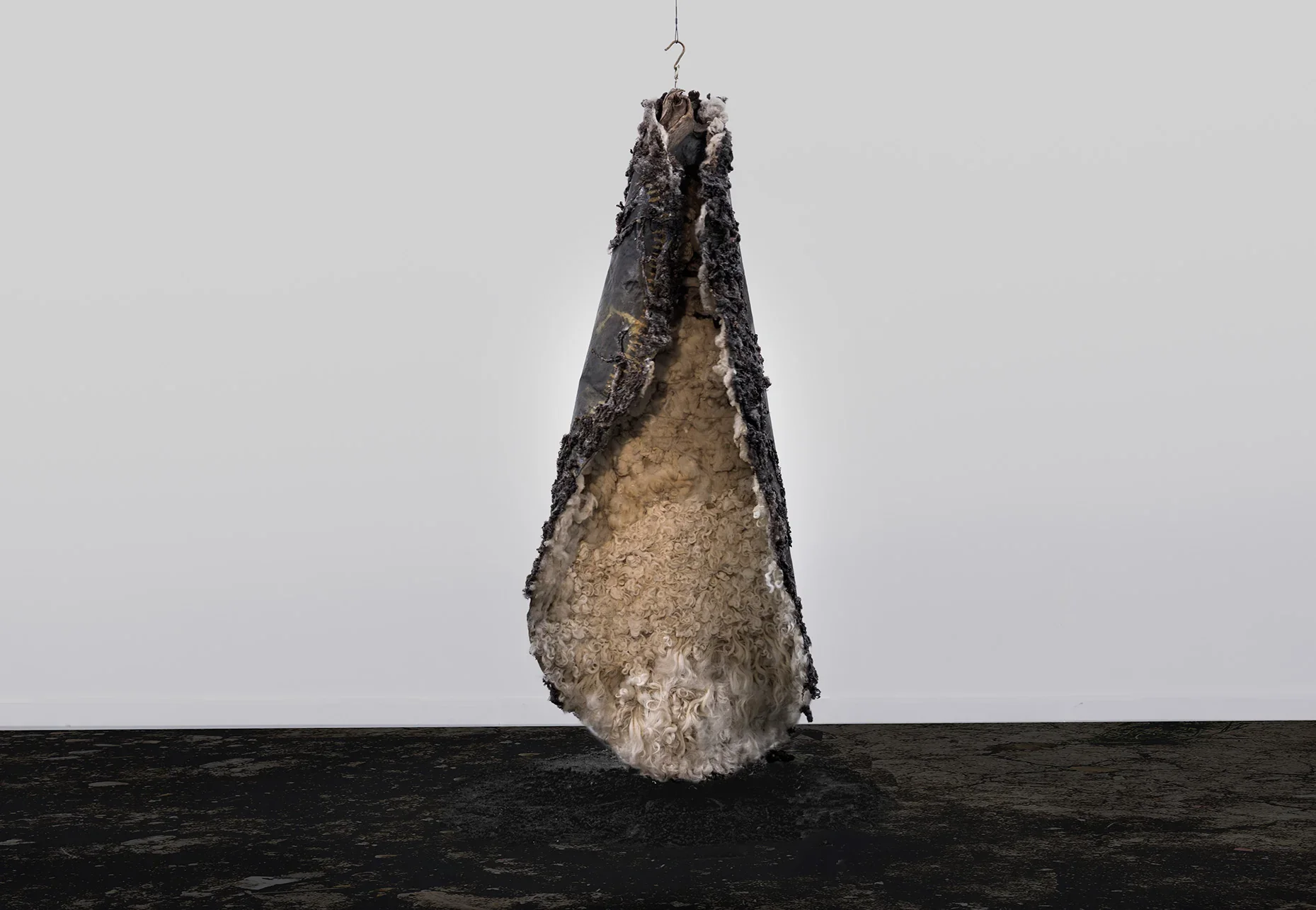
Monica Perez. COST.10M. Water-based media, British Devon & Cornwall Longwool locks, British tri-coloured Shetland raw wool, British Greyface Dartmoor (pedigree rare-breed) raw wool, British Wensleydale (black/silver washed, rare-breed) raw wool, wax, foraged eucalyptus wood (Uruguay), mudlarked Thames River wood, brass butcher hook, canvas. 120cm x 244cm x 101 cm. 2025.
The Wool Trade boomed.
The Salsipuedes Massacre took place on 11 April 1831 at the banks of the Arroyo Salsipuedes. It was carried out under Fructuoso Rivera, Uruguay’s first president, with the participation of the national army. Charrúa leaders and communities were summoned under the premise of negotiation and assistance, then attacked. The massacre transformed a political meeting into a state operation of elimination.
Four Charrúa survivors — Vaimaca Perú, Senaqué, Guyunusa, and Tacuabé — were later sent to France and exhibited in Paris as ethnographic curiosities. Their removal turned Indigenous survival itself into spectacle. In this aftermath, the Charrúa body became evidence of conquest, displayed for European audiences at the same time that European markets consumed the material products of South American land.
Between 1850 and 1900, Uruguay sent an estimated 10 million sheep to Britain, becoming a key supplier in the wool trade. During this time, sheep were selectively bred to produce higher-value wool—part of a larger system that shaped animals, land, and labor to meet the demands of empire.
In the 19th century, the British turned Uruguay’s Pampas into vast sheep pastures. Wool was shipped back to England to fuel the textile industry, while the land was seized, Indigenous communities were displaced, and economies were restructured to serve imperial markets. Surviving Charrúa people were taken prisoner, displaced, and forced toward Montevideo. Many were separated from their communities and absorbed into systems of servitude, domestic labour, trafficking, and forced assimilation.
For those in Britain, wool arrived cleanly in silence—its violent origins obscured. Wool is not neutral. It is politically charged. Its softness belies the weight it carries: of land taken, cultures erased, and lives lost. Each work in Cost is a node in a wider rhizomatic network—linking bodies, time, trade, and silence.
Perezs’ works are not named, but numbered in increments of years, weights, durations, values. This is intentional acting as a ledger; a refusal to forget and a way to mark what history tried to erase.
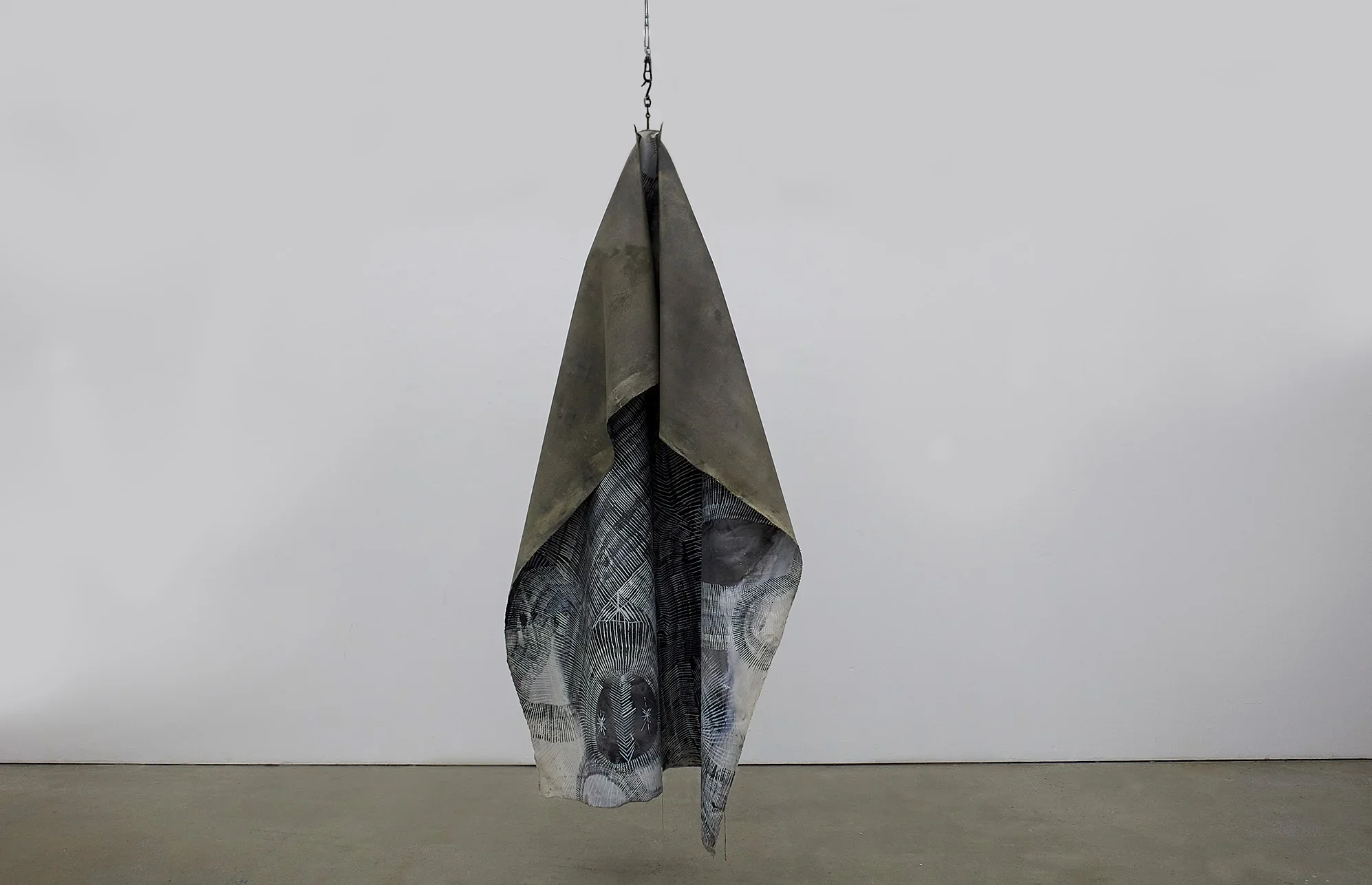
Monica Perez. COST.176. Water-based media, charcoal, oil, wax, canvas. 120cm x 244cm x 101 cm. 2025.
The massacre created the conditions for a reordered landscape.
Salsipuedes marks the point where Uruguayan state formation, Indigenous elimination, and territorial reorganisation converge. The massacre cleared more than bodies from the land; it cleared memory, legal claim, and collective presence. It made the Pampas available to a new economic order in which land could be measured, stocked, grazed, exported, and folded into Atlantic trade.
The expansion of sheep grazing in Uruguay converted the Pampas into a pastoral economy structured around export. This was not simply agricultural development. It was a transformation of territory into supply infrastructure. Land that had held Indigenous presence, movement, memory, and relation was reorganised around animals, fences, markets, shipping, and textile demand.
176 Indigenous languages have been lost across South America.
Uruguay’s later national memory often depended on the fantasy of Indigenous disappearance. The Charrúa were treated as vanished, absorbed, or mythic, while descendants and surviving histories persisted beneath official narratives. COST interrupts this amnesia by returning the Charrúa to the material surface of wool, soil, wax, hair, wood, and pigment.
The event at Salsipuedes cannot be separated from the later economy of wool. The wool trade then carried that reordered landscape outward, allowing violence to circulate as softness, warmth, textile, and wealth. This is the historical charge of Perez’s material: wool becomes a residue of a colonial event that the enlightenment tried to make invisible.
Written By Monica Perez
With additional research and text contributions by Jozef Michalski
Footnote:
COST is an ongoing project by Uruguayan artist Monica Perez, developed through painting, sculpture, installation, and material research. The project traces the colonial legacy of raw wool between England and Uruguay, examining how extraction, Indigenous dispossession, animal exploitation, trade, and historical omission persist through material form and national memory. Centred on wool as a politically charged substance rather than a neutral textile, COST follows the transformation of Uruguay’s Pampas into sheep-grazing territory during the nineteenth century and connects this economic restructuring to the Salsipuedes Massacre, the near-erasure of the Charrúa, and the Atlantic commodity routes through which colonial violence entered European material culture. Perez’s works use wool, wax, soil, canvas, pigment, clay, wood, hair, and found objects as mnemonic materials: substances that hold historical pressure, ecological damage, bodily trace, and cultural erasure. The series is structured through numbers, dates, weights, quantities, and values, forming a material ledger of what trade, state history, and Eurocentric narratives attempted to render invisible.
Editors: Oriana Anthony & Jozef Michalski.