
Woman in Mind: The Politics of Quiet
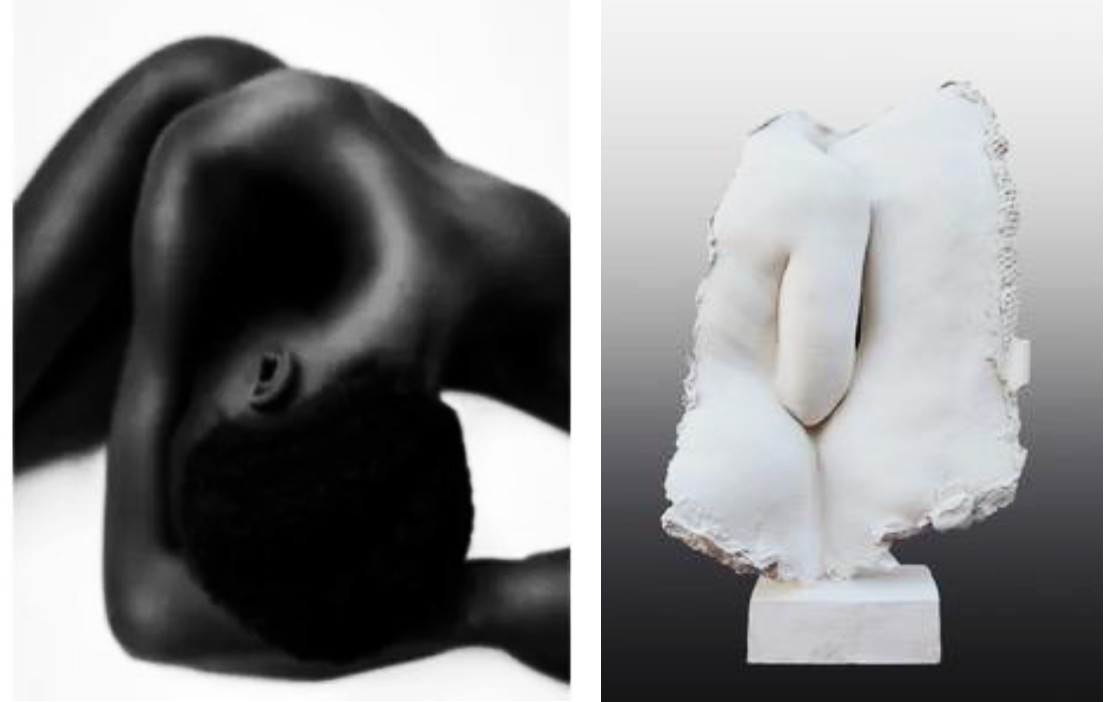
Maryam Eisler, Phenomenal Woman Printed with archival pigment ink on Hahnemuhle William Turner (Cotton Rag 310gsm) laid down on aluminium 158 x 110 cm (on the left)
Nicole Farhi CBE MRSS La Douceur ed 1/6 Jesmonite 2021, H72x depth 10cm Base Hx W 17xL: 23cm (on te right
There is something almost unfashionable about Woman in Mind.
In an era in which identity is increasingly performed through visibility and exposure, Dragon Hill's exhibition of works by photographer Maryam Eisler and sculptor Nicole Farhi turns towards restraint, interiority and contemplation. The exhibition, produced by Catherine Hunt and curated by Catherine Loewe centres on presence: bodies, fragments, folds, curves, shadows and sculptural forms that hover between abstraction and figuration.
The distinction matters.
The exhibition repeatedly returns to ideas of containment and interior life. Faces disappear. Biography recedes. Narrative remains secondary. What emerges are bodies that operate simultaneously as physical forms, emotional states and symbolic landscapes. Woman in Mind asks what it feels like to inhabit a feminine condition that exceeds individual identity.
This is a risky proposition.
Contemporary art has spent decades revealing the social and political structures through which femininity is constructed. We have become accustomed to questions of representation and power. Woman in Mind redirects attention towards emotional truth. Curator Loewe positions both artists within a lineage of the Feminine Sublime, drawing on Carl Jung's understanding of feminine energy as "a powerful and necessary energy that, when integrated, allows us to move beyond a purely patriarchal worldview towards one that is circular, interconnected and life-affirming." Loewe locates resistance in emotional truth and sacred beauty. Her reading of the Feminine Sublime positions tenderness and introspection as forms of agency capable of expanding cultural frameworks shaped by patriarchal assumptions. It may sit uneasily within contemporary feminist discourse, yet it helps explain the exhibition's commitment to them as meaningful forms of agency.
Such claims inevitably provoke questions.
Can woman ever be separated from the social and economic realities that shape her life? Does the removal of identity markers create space for broader forms of identification? Can abstraction reveal dimensions of experience that remain inaccessible through biography alone?
Woman in Mind leaves these questions open.
Farhi's sculptures and Eisler's photographs occupy a productive ambiguity. Their works hover between body and landscape, individual and archetype, flesh and memory. A shoulder becomes a horizon. A fold of skin resembles geological terrain. The female body transforms into something simultaneously intimate and universal.
There is a long history to this move. The female nude has served for centuries as the primary site upon which Western art projected fantasies of beauty, virtue and desire. What distinguishes Woman in Mind is the perspective through which these images emerge. Eisler and Farhi approach femininity as a lived condition of authorship. Their works suggest forms of femininity that are vulnerable and strong, sacred and profane, quotidian and universal.
Loewe speaks of women as daughters, sisters, mothers and grandmothers while locating creative impulse at the centre of feminine experience. Creation itself becomes a form of agency, authority and power. In her words, "our creative impulse remains fundamental to who we are. It is a form of divinity and authorship that history has too often reserved for men."
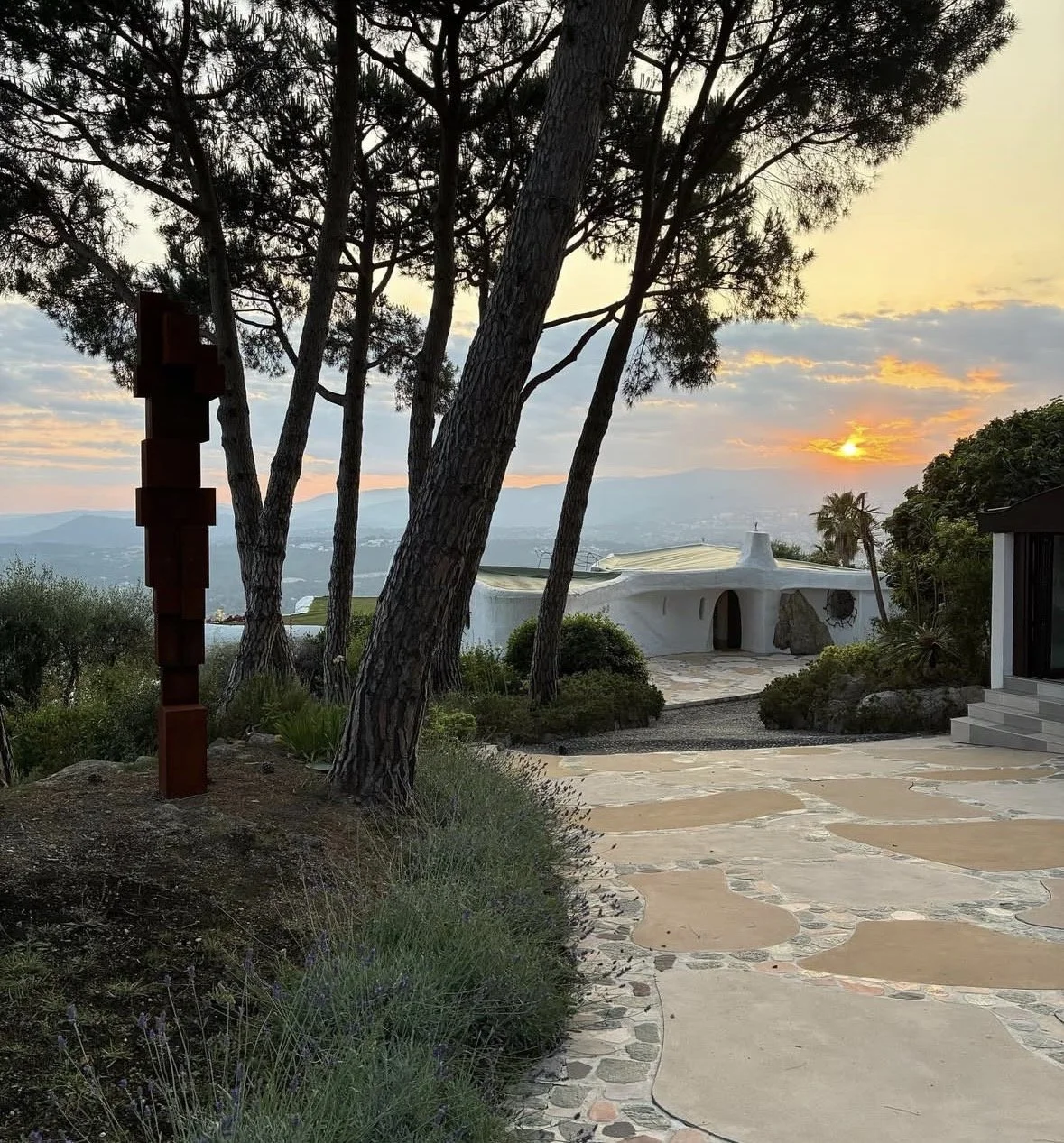
Dragon Hill, France
The setting amplifies this proposition. Dragon Hill, Jacques Couëlle's extraordinary "inhabited sculpture" on the French Riviera, functions as an extension of the exhibition's intellectual framework. Designed in 1964 as an organic continuation of the landscape, the house dissolves conventional boundaries between architecture, nature and sculpture. Curved walls emerge from the hillside, rooms flow into one another, and the building itself seems to have grown from the earth. Today, under the stewardship of Joe Kennedy and Jonny Burt, Dragon Hill operates as a residency and cultural refuge where artists can step away from the accelerated rhythms of contemporary life to reflect, research and create.
In this context, Woman in Mind unfolds as part of a larger conversation about presence and the spaces in which alternative ways of being can emerge. Dragon Hill becomes more than a venue. It acts as a participant in the exhibition, embodying the slower rhythms and attentiveness that the works invite.
At a moment when contemporary culture rewards speed and visibility, Woman in Mind insists upon ambiguity and contemplation. Presence becomes a form of resistance. Beauty becomes a mode of attention. Interiority emerges as a space where meaning continues to unfold beyond the demands of performance.
By Laura Dzelzytė